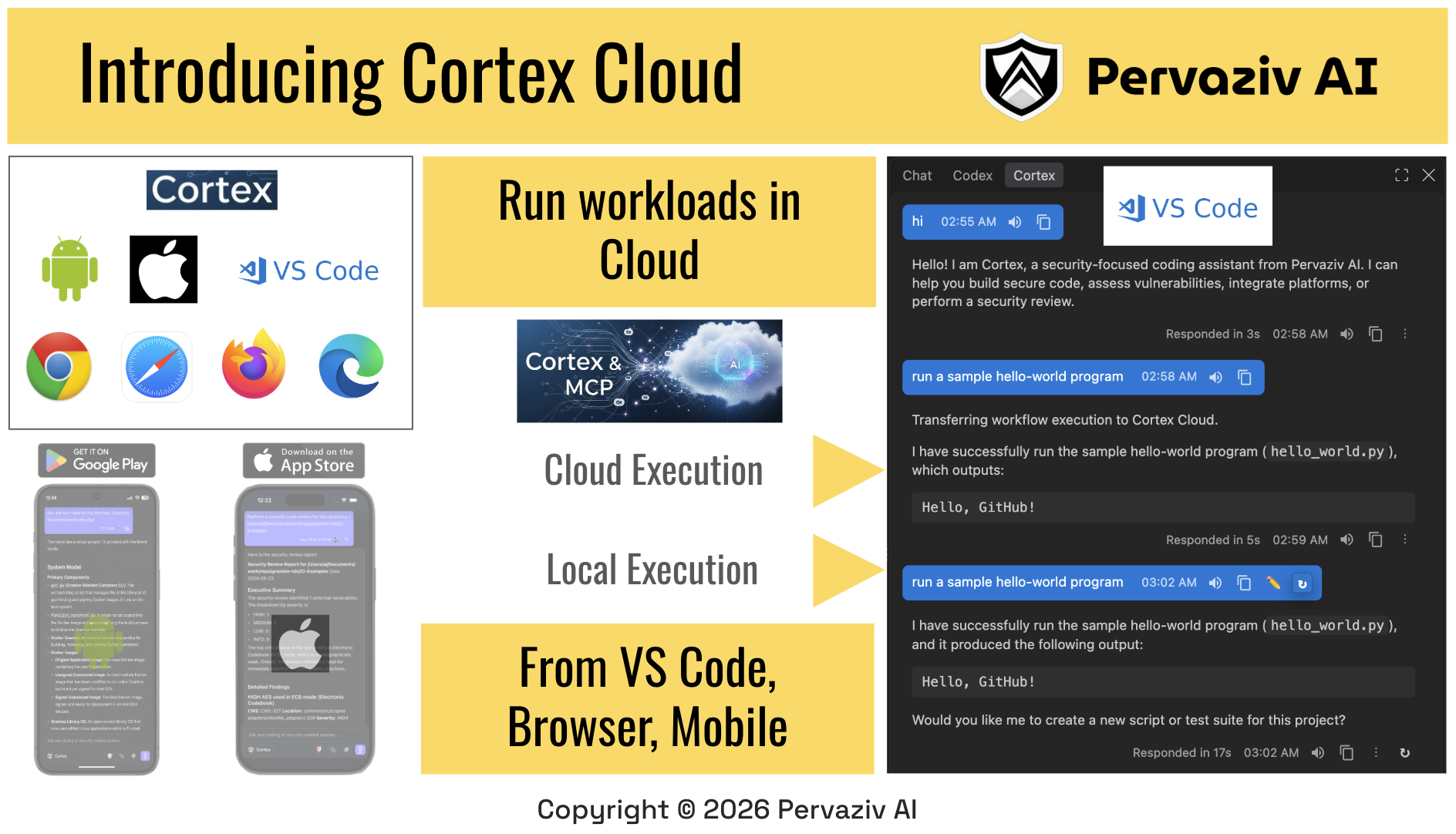
Cortex Cloud extends Cortex Connect with local or managed cloud execution across mobile, browser and VS Code, with durable state and enterprise control.
SAN FRANCISCO , CA, UNITED STATES, September 10, 2026 /EINPresswire.com/ — Pervaziv AI today announced Cortex Cloud, a managed cloud execution layer for Cortex that gives users a clear choice between Local execution and durable remote execution through Cortex Cloud.
The release advances Cortex as an Enterprise AI Control Layer connecting human intent, specialized intelligence, project context, workflow state and governed execution.
Cortex Cloud builds directly on Cortex Connect, introduced in August to create continuity across mobile, browser and Visual Studio Code. Cortex Connect made it possible for a request to begin where the need appeared, remain visible across work surfaces and reach the connected development workspace where the relevant project context lived. Cortex Cloud expands that model by adding a managed execution destination for eligible work that should continue remotely.
A developer can start from Visual Studio Code, a browser or mobile, choose Local or Cortex Cloud, follow progress and return to a result connected to the original workflow and project.
## Executive Commentary
————————————
“Enterprise AI becomes far more useful when work can continue without being tied to one device, one session or one environment,” said Anoop Jaishankar, Founder and CEO of Pervaziv AI. “Cortex Cloud gives that work a durable place to run while keeping the user, project state, execution boundary and result connected. It moves Cortex another step from assisting with individual moments to carrying work through to controlled, reviewable outcomes.”
Irina Calciu, Founding Systems Architect at Pervaziv AI, who played a key role in the Cortex Cloud project, said, “Reliable cloud execution starts with knowing exactly what work is being performed, against which project state and within which controls. Cortex Cloud gives eligible engineering tasks a dedicated environment with the appropriate repository state, tools, permissions and organizational policies, then returns the result through the same connected workflow. Whether investigating a failing build, reproducing a defect, remediating a vulnerability or updating a dependency, the work becomes more reproducible, inspectable and recoverable when something goes wrong.”
The launch follows Pervaziv AI’s recent work on long running AI reliability. Cortex semantic context compaction, announced earlier this month, was designed to preserve the facts, decisions, constraints and authoritative references that determine correctness as workflows grow across conversations, files and tools. Cortex Cloud applies the same broader principle to execution: preserve the durable state that determines what the workflow is, where it belongs, what project revision it uses and how the user can continue.
## Cortex Cloud Adds Execution Reach
—————————————————-
Modern engineering work rarely begins and ends in one place. A developer may discover a compatibility issue while reading documentation in a browser. An engineering leader may need to initiate a bounded task from a phone. A developer may start a larger request in Visual Studio Code and want the work to continue without keeping the editor session active.
Cortex Connect addressed the continuity problem. It connected the user, conversation, project and progress across supported work surfaces. Its first execution model remained centered on the connected development workspace, where code, tools and developer context already existed.
Cortex Cloud extends the execution boundary.
Users can keep eligible work Local when the connected machine is the right environment, or choose Cortex Cloud when the workflow benefits from a managed remote destination. The objective remains consistent. The conversation remains in Cortex. The selected execution destination changes without forcing the user to reconstruct the task or move into a separate cloud interface.
That distinction turns Cortex Connect from a bridge between screens into a connected execution layer spanning personal development environments and managed cloud capacity. Cortex Connect allows the experience to move with the user. Cortex Cloud allows eligible execution to move with the workflow.
## A Simple Local or Cortex Cloud Choice
——————————————————-
The most visible part of Cortex Cloud is intentionally simple.
Cortex now presents a compact execution selector across Visual Studio Code, supported browsers and mobile. Within an authenticated Cortex session, users can choose Local or Cortex Cloud directly from the experience.
Local execution keeps eligible work close to the connected development environment and its available project context. Cortex Cloud directs eligible work into a managed remote execution environment designed for durable, project aware workflows.
The selected destination is more than a display preference. It is an execution boundary. If a user chooses Cortex Cloud, the platform does not silently fall back to Local execution when the managed cloud path is unavailable. If the cloud path cannot proceed, Cortex returns an appropriate state rather than erasing the distinction between personal development infrastructure and managed cloud infrastructure.
Convenience should not override intent about where work is allowed to run.
## Managed Cloud Workspaces Grounded in Project State
Remote execution becomes useful only when the system can answer a basic question with confidence: what exact project state did the work use?
For project aware cloud workflows, Cortex Cloud uses a stable committed source revision as the basis for handoff. The connected development workspace establishes the project relationship, while Cortex checks that the source state is suitable for remote execution.
Uncommitted local edits are not silently treated as though they already exist in the cloud. If the working copy is not in an eligible state, Cortex stops the handoff and gives the user a clear opportunity to prepare the project first.
That creates a stronger basis for repeatability and review. Developers and teams can understand the exact starting point used by the remote workflow and relate the result to the source revision that was acted upon.
Once the handoff is eligible, Cortex Cloud prepares a managed, isolated execution workspace associated with the authorized user, project and workflow. The platform handles workspace and compute placement behind the product boundary, subject to organizational controls and availability.
## Durable Work That Does Not Depend on One Open Screen
———————————————————————————–
Cloud execution should not depend on a chat panel remaining open.
Cortex Cloud is designed around durable workflow state. The active client is a view into the work, not the sole owner of it. A browser refresh, laptop sleep, mobile network change or temporary interruption does not need to turn an active task into an unknown outcome.
Cortex records the workflow state needed to associate cloud work with the correct user and project, preserve meaningful progress and restore the latest durable state when the user returns. Completion, cancellation, attention states and terminal outcomes remain part of the workflow rather than disappearing with a client connection.
As AI assisted engineering becomes more operational, a useful task may outlast one interactive prompt. Users should be able to leave a surface and return without wondering whether the work stopped, completed or needs to be submitted again.
## Progress Across Mobile, Browser, Visual Studio Code and DevSecOps
———————————————————————————————–
Cortex Cloud is designed to strengthen the distinct role of each Cortex surface rather than make every interface imitate an IDE.
On mobile, users can initiate eligible work, follow progress, see when a workflow needs attention and return later for review. The phone remains a control surface rather than a compressed desktop development environment.
In the browser, Cortex can stay close to documentation, pull requests, issue trackers, dashboards, knowledge systems and other enterprise context where a need may first become visible. A user can identify an objective there, choose Cortex Cloud and keep the workflow connected to the relevant project.
Visual Studio Code remains central for understanding project structure, making local changes, reviewing diffs and deciding when work is ready to share. Developers can choose Local when the workstation is the right execution destination or Cortex Cloud when managed remote execution better fits the task.
The DevSecOps Task Center provides a broader Cloud Workflows view for active and completed work. It presents customer appropriate state such as progress, outcome, region when applicable, available actions and useful error guidance without turning cloud infrastructure into a separate customer control plane.
## From Three Routers to an Execution Destination
——————————————————————–
Cortex Cloud also extends the coordination architecture Pervaziv AI has been building across the platform.
Cortex Model Routing helps connect a request with the appropriate form of specialized intelligence. Search Routing determines when current public information can improve the work. Skill Routing brings focused engineering practices into the workflow. Cortex Planner can structure larger objectives. Cortex Connect keeps intent, progress and project relationship joined across work surfaces. Semantic context compaction helps preserve what matters as that work grows.
Cortex Cloud adds another question: where should eligible work execute?
These responsibilities are intentionally separated. The model best suited to a request does not need to determine the user’s execution boundary. Search providers can evolve without redefining the project environment. Engineering skills can become more specialized without exposing their internal organization. Cloud capacity can change behind the platform without requiring users to learn a new infrastructure interface.
For the customer, the objective stays central while the complexity underneath can evolve.
## Enterprise Control Without Infrastructure Overload
————————————————————————
Pervaziv AI designed Cortex Cloud around the idea that enterprise control does not require every user to become a cloud operator.
Cloud execution is available through authenticated Cortex sessions. Workflows remain associated with ownership boundaries, project state and the selected execution destination. Organizational and regional policies can influence eligibility and placement. Capacity and usage can be managed centrally. Lifecycle behavior, retention and cleanup remain platform responsibilities.
Operational visibility is also designed around bounded metadata rather than ordinary exposure of customer content. Useful service signals can include workflow state, timestamps, region, resource usage, outcome category, retry guidance and lifecycle events. This gives operators and business leaders information about service behavior and adoption while keeping raw customer code and conversation content out of routine monitoring surfaces.
Failure is treated as a state to explain, not a generic error to hide. A project may not be ready for handoff. A policy may not permit the requested destination. Capacity may be unavailable. A remote task may stop before completion. Cortex is designed to distinguish those conditions so users can understand whether preparation, retry, review or another action is required.
That clarity is part of enterprise trust: users need to know where the system acted, what state it used and what happened when the expected path could not proceed.
## Extending Productive Time Without Extending Complexity
———————————————————————————-
For developers, Cortex Cloud adds another execution option without requiring a separate cloud job system. Work can continue in a managed environment while the user moves to another task or another device, and the result remains tied to the original objective.
For engineering leaders, durable workflow state creates better visibility into work that would otherwise live on an individual laptop or inside a temporary session. Active, completed and attention requiring states can be understood through Cortex rather than reconstructed from scattered updates.
For platform teams, Cortex Cloud creates a foundation for centrally managed execution capacity behind a stable product interface. Policy, regional availability, workload admission and resource controls can evolve without being reimplemented in every client.
For distributed teams, the workflow becomes less dependent on the device or location from which it began. A user can initiate work in one place, follow it elsewhere and return to the project for review.
Cortex Cloud extends when and where AI assisted engineering work can continue while preserving a consistent interaction model.
## From Answers to Outcomes, Now With a Managed Place to Run
—————————————————————————————–
The Cortex roadmap has increasingly separated the responsibilities required to turn AI capability into dependable enterprise work.
The Cortex AI Model Ensemble established specialized intelligence. Cortex Router created a coordinating entry point. Cortex Planner added structured planning. Search Router and Skill Router connected requests with current information and engineering discipline. Cortex Connect linked the user, conversation and project across mobile, browser and Visual Studio Code. Semantic context compaction strengthened continuity as longer workflows accumulate more history and evidence.
Cortex Cloud now extends that path into managed execution.
The significance is not simply that code or tools can run somewhere other than a laptop. Cloud compute is a resource. Cortex Cloud turns that resource into a governed continuation of the workflow, tied to an authenticated user, a defined project state, an explicit execution destination, durable progress and a result that returns through the same Cortex experience.
“The defining change is that execution becomes part of the Cortex workflow rather than a separate system the user has to manage,” Jaishankar said. “The objective, project state, execution choice, progress and result stay connected. That is what lets managed cloud capacity increase the reach of Enterprise AI without increasing the operational burden on the user.”
That is a different product model from an AI assistant that answers a question and leaves the user to coordinate everything that follows.
Cortex is being built around a broader contract: understand the objective, coordinate the appropriate intelligence and information, preserve the context that still governs the outcome, respect execution boundaries, keep the work visible and return a result people can review.
## Why This Matters for Enterprise AI Adoption
—————————————————————
As organizations move from AI experimentation toward AI assisted engineering, the limiting factor is increasingly not whether a model can generate code. It is whether the surrounding system can carry work across time, devices, project boundaries and operational constraints without losing accountability. Cortex Cloud addresses that system level gap.
The release gives enterprises a path to use managed execution without replacing the developer environment or exposing infrastructure as another product users must operate. Teams can keep local work local when that is the right boundary, use managed cloud capacity when remote execution is appropriate, and preserve a consistent Cortex workflow across both choices.
For organizations evaluating agentic engineering platforms, that hybrid model can be important. It supports greater execution reach while keeping source state, identity, ownership, progress and result continuity explicit. The goal is not cloud execution for its own sake. It is a more dependable way to turn AI assisted intent into work that remains understandable from start to finish.
## A Foundation for Broader Cortex Cloud Capabilities
————————————————————————
The initial Cortex Cloud release focuses on the fundamentals required for dependable managed execution: Local or Cortex Cloud selection, durable workflow state, project aware handoff, managed workspaces, remote capacity, cross surface progress, clear completion and enterprise controls.
Advanced cloud capabilities depend on a reliable foundation for identity, source state, workflow ownership, execution placement, interruption recovery and result continuity. Cortex Cloud establishes that foundation inside the same Enterprise AI Control Layer customers already use across developer tools, browsers, mobile and DevSecOps.
With Cortex Connect, the question became less about which screen owns the conversation and more about where work can be completed with the right context and control. Cortex Cloud expands the answer.
One request can begin on mobile, browser or Visual Studio Code. One connected workflow can carry the intent forward. One explicit choice determines whether eligible work stays Local or runs through Cortex Cloud. The project remains grounded. Progress remains visible. The user remains in control.
Pervaziv AI
Pervaziv AI
email us here
Visit us on social media:
LinkedIn
Instagram
YouTube
X
Other
Legal Disclaimer:
EIN Presswire provides this news content “as is” without warranty of any kind. We do not accept any responsibility or liability
for the accuracy, content, images, videos, licenses, completeness, legality, or reliability of the information contained in this
article. If you have any complaints or copyright issues related to this article, kindly contact the author above.

Media gallery