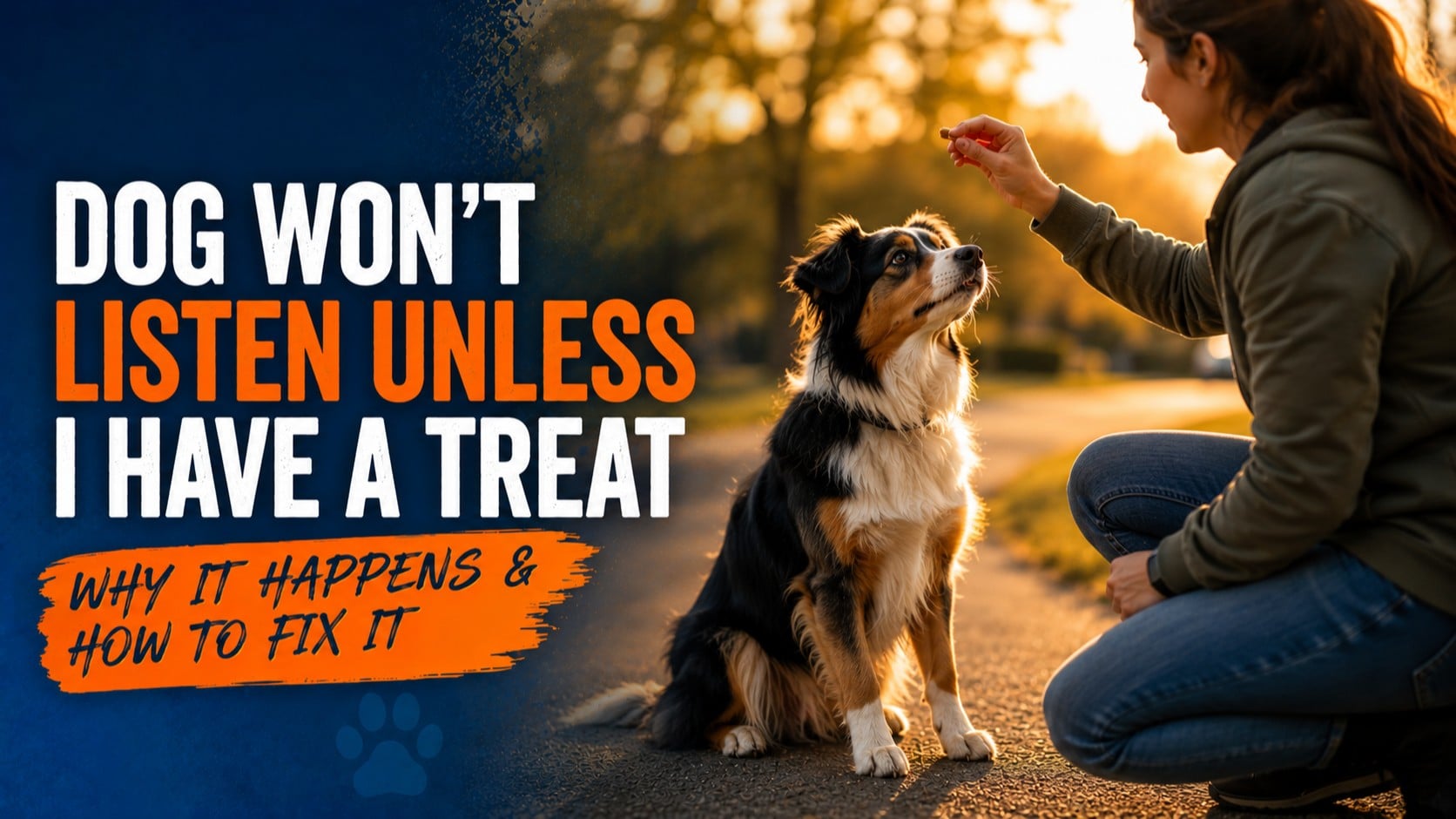
Key Takeaways:
- Dogs that only respond with treats visible weren’t actually taught the verbal command—they learned to follow food movements instead
- Three critical training mistakes create treat dependency: never fading food lures, showing treats before commands, and skipping variable reward schedules
- Professional training uses concealed reinforcement and systematic environment proofing to build genuine obedience without treat reliance
- Board-and-train programs address treat dependency through intensive, consistent training that most households cannot replicate on their own
When a dog sits perfectly in the kitchen but stares blankly at the park, most owners assume their pet is being stubborn or defiant. The reality is far more precise: the dog was never actually taught the behavior in the first place. Instead, it learned to follow food—a completely different skill that breaks down the moment treats disappear from view.
Your Dog Learned to Follow Food, Not Commands
The mechanism behind treat dependency is straightforward once understood. When food is used as a lure—held in hand and moved through space to guide a dog into position—it functions as a signal that comes before the behavior. Because food triggers such a powerful biological response, a dog’s learning system latches onto it with remarkable speed. Research shows a food lure can become the functional cue for a behavior in as few as three repetitions.
What the dog actually learns is not “sit means put my hindquarters on the floor.” Instead, the dog learns “when the hand moves in that particular way with that particular smell, I should sit.” Remove the hand movement, the smell, and the visible treat, and the cue—from the dog’s perspective—has never been given. Professional training programs address this fundamental training gap through systematic methods that build genuine stimulus control rather than food-following behaviors.
This explains why a dog might perform flawlessly during training sessions but appear completely confused when asked for the same behavior without treats present. The verbal word “sit” was merely background noise that happened to coincide with the real cue: the treat movement. From the dog’s learning system, the owner is essentially speaking a foreign language when no food is visible.
Why Dogs Stop Responding When Treats Disappear
Understanding why treat-dependent behaviors collapse requires examining what dogs actually learned during training. Three specific learning failures create this dependency, each stemming from how the human brain processes training differently than the canine brain.
1. Food Lures Become the Real Command
When food consistently appears before a behavior, the dog’s nervous system incorporates that food signal into the cue definition itself. The treat isn’t just motivation—it becomes part of the command structure. Dogs trained this way develop what behaviorists call “conditional stimulus control,” where the behavior only occurs when specific environmental conditions (visible food) are met. Without those conditions, the dog genuinely doesn’t recognize that a command has been given.
2. Your Dog Never Actually Learned the Word ‘Sit’
Most dogs in treat-dependent situations respond to a complex combination of hand movement, body language, treat smell, and ambient environmental cues—with the verbal word being the least important component. When trainers test this by giving verbal commands from another room or with hands empty and motionless, many “trained” dogs show no response whatsoever. The word itself never gained meaning because it was never isolated as the controlling stimulus.
3. Environmental Context Confusion
Dogs are contextual learners who incorporate far more environmental information into learned behaviors than owners realize. A dog trained only in the kitchen learns a “kitchen behavior,” not a universal one. The flooring, lighting, handler position, time of day, and even the presence of a treat pouch on the owner’s body become part of the learned behavior chain. This explains why perfectly trained kitchen dogs appear completely untrained at the park—the environmental picture looks so different that the dog’s learning system doesn’t recognize the scenario.
The Three Training Mistakes Creating Treat Dependency
Treat dependency doesn’t form because owners used food in training—it forms because of specific, identifiable mechanical failures in how that food was introduced and managed throughout the learning process.
Never Fading the Food Lure
The most fundamental mistake is using food as a lure without ever transitioning away from visible treats. Luring serves as useful scaffolding for teaching new behaviors, showing dogs what movements to make without requiring prior knowledge. However, if training never progresses beyond this stage, the food movement becomes permanently embedded in the dog’s understanding of what triggers the behavior. Professional training protocols specifically address this by gradually removing visible food (fading) while maintaining the behavior through other reinforcement methods.
Showing Treats Before Commands (Bribing)
When dogs don’t respond to commands, frustrated owners often retrieve treats from pockets and show them to motivate compliance. This creates a learned contingency where the dog discovers that ignoring commands leads to the appearance of food. The dog learns to hesitate and wait, knowing that non-compliance triggers treat visibility. This pattern trains hesitation as a behavior that produces rewards, creating dogs who reliably stall before responding to any command.
Skipping Variable Reward Schedules
Continuous reinforcement—giving treats after every correct response—creates expectation problems when rewards become inconsistent. Dogs trained on continuous schedules come to expect food on every repetition, and removing treats feels like the behavior has stopped paying. Variable ratio reinforcement, where rewards come unpredictably after different numbers of correct responses, creates much more durable behaviors because the dog cannot predict when the next reward will arrive.
Why Your Quick Fixes Make It Worse
When owners discover their dog’s treat dependency, several instinctive solutions present themselves. Unfortunately, most of these common fixes worsen the problem by destabilizing the dog’s motivation system without replacing it with anything functional.
Going Cold Turkey on Treats
The most common response—removing treats entirely—ignores what happens to behavior when reinforcement suddenly disappears. Abrupt removal triggers what behaviorists call an “extinction burst,” where the dog initially tries harder before the behavior collapses entirely. The dog that was previously engaging with training, however imperfectly, may stop responding altogether. Owners interpret this shutdown as confirmation their dog is untrainable, when the real issue is destabilized motivation architecture.
Repeating Commands When Ignored
Giving commands multiple times when dogs don’t respond creates “command poisoning,” where repeated presentation of unresponded-to cues reduces their discriminative value. Each repetition teaches the dog that the word doesn’t necessarily require immediate action. Dogs learn that “sit” might be ignorable, but “sit-sit-SIT” might require response. This makes the original cue less effective than before the repetitions started.
Using High-Value Treats as Bribes
Escalating to premium treats when dogs ignore regular commands teaches dogs that non-compliance produces better rewards. The behavior gets produced temporarily, which feels like progress, but the dog learns that hesitation leads to upgraded food options. This creates dogs who strategically delay compliance, waiting to see what level of reward their resistance might generate.
How Professional Training Fixes Treat Dependency
Professional training systems address treat dependency through systematic progressions that most household training approaches miss entirely. The difference lies not in avoiding food rewards, but in how and when those rewards are delivered throughout the learning process.
1. Concealed Reinforcement and Bridging Markers
Professional trainers use concealed reinforcement systems where food is hidden in pouches or kept out of sight until after the behavior occurs. A bridging marker—either a clicker or consistent verbal marker like “yes”—allows precise timing of the reward moment without the dog seeing food beforehand. This creates the sequence: cue → behavior → marker → concealed food delivery. Dogs learn that rewards follow compliance rather than appearing before commands, eliminating the treat-visibility dependency.
2. Systematic Environment Proofing
Generalization must be built deliberately across varied environments and distraction levels. Professional training includes systematic exposure to progressively challenging scenarios: different rooms, outdoor spaces, various surface types, and increasing levels of environmental stimulation. At each new environment, criteria are temporarily lowered and reinforcement temporarily increased while the dog learns that the same commands apply regardless of context.
3. Variable Ratio Reinforcement Schedules
Professional programs transition from continuous reinforcement to variable ratio schedules, where rewards come after unpredictable numbers of correct responses. This unpredictability creates more persistent behavior because dogs cannot determine when reinforcement will stop coming. The same psychological mechanism that makes slot machines compelling operates in dog learning—behaviors maintained on variable schedules become remarkably durable and resistant to extinction.
4. Life Rewards Beyond Food
Advanced training incorporates naturally occurring rewards that dogs encounter throughout their daily routines: door access for walks, meal placement, car exits at parks, and social interaction opportunities. These life rewards teach dogs that compliance produces access to things they already want, reducing dependence on carried treats while building motivation around normal household activities.
How Board-and-Train Programs Address Food Dependency
Board-and-train programs offer specific advantages for addressing treat dependency that are difficult to replicate in typical household training situations. The intensive, controlled environment allows for the volume of repetitions and consistency necessary to rebuild genuine stimulus control from the ground up.
Professional trainers can implement systematic fading protocols over multiple weeks, moving through careful progressions from lured behaviors to concealed reinforcement to variable reward schedules. This level of methodical progression requires hundreds of repetitions across diverse scenarios—a training volume that’s extraordinarily difficult to achieve in normal household routines where training happens sporadically between daily activities.
The controlled environment also allows trainers to address environmental generalization systematically. Dogs practice commands in multiple rooms, outdoor areas, and public spaces with professional guidance at each transition point. This ensures that behaviors become truly universal rather than context-dependent, addressing one of the primary factors that makes household-trained dogs appear unreliable in real-world situations.
For dogs struggling with treat dependency or owners seeking reliable obedience without constant food bribes, professional board-and-train programs provide structured approaches designed to build genuine stimulus control and real-world reliability.
Camp Lucky Board and Train
503 NW Falk Dr
Lee’s Summit
MO
64063
United States