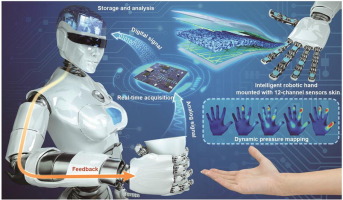
Humanoid robot sensors serve as the sensory system of robots, enabling functionalities such as vision, touch, motion detection, navigation, environmental
AUSTIN, TX, UNITED STATES, June 1, 2026 /EINPresswire.com/ — The Global Humanoid Robot Sensors Market is witnessing unprecedented growth as advancements in artificial intelligence, machine learning, robotics, and automation continue to reshape industries worldwide. Valued at USD 1,842 million in 2025, the market is projected to reach approximately USD 9,218 million by 2032, registering a remarkable CAGR of 25.8% during the forecast period of 2026–2032. The increasing deployment of humanoid robots across manufacturing, healthcare, logistics, retail, defense, and service industries is significantly driving demand for sophisticated sensor technologies that enable robots to perceive, analyze, and interact with their surroundings.
Humanoid robot sensors serve as the sensory system of robots, enabling functionalities such as vision, touch, motion detection, navigation, environmental awareness, and human-machine interaction. As organizations increasingly adopt intelligent automation solutions, sensor technologies are becoming more advanced, compact, energy-efficient, and capable of delivering real-time data processing. These developments are positioning sensor manufacturers at the forefront of the rapidly evolving humanoid robotics ecosystem.
Get a sample of the report: https://www.maximizemarketresearch.com/request-sample/301991/
Market Growth Driven by Rising Adoption of Intelligent Robots
The growing demand for automation and labor optimization across industries remains one of the primary growth drivers of the humanoid robot sensors market. Manufacturers are increasingly deploying humanoid robots to perform repetitive, hazardous, and precision-based tasks, reducing operational costs while improving productivity and workplace safety. Advanced sensors enable these robots to navigate complex environments, identify objects, recognize human gestures, and perform delicate operations with high accuracy.
Healthcare represents another major growth avenue for humanoid robot sensors. Hospitals and elderly care facilities are utilizing humanoid robots for patient assistance, rehabilitation, medication delivery, and social interaction. These applications require highly sensitive vision sensors, force sensors, proximity sensors, and motion sensors that allow robots to safely interact with patients and healthcare professionals.
The logistics and warehouse sector is also contributing substantially to market expansion. Humanoid robots equipped with advanced sensing systems are increasingly being used for inventory management, package sorting, autonomous navigation, and last-mile delivery support. The rapid growth of e-commerce continues to create significant opportunities for sensor manufacturers serving the robotics industry.
Recent Developments Transforming the Industry
The humanoid robotics industry has witnessed several technological breakthroughs in recent years. Leading robotics companies are developing next-generation humanoid robots equipped with multimodal sensing capabilities that combine vision, touch, sound, and environmental awareness into a unified system.
Sensor manufacturers are increasingly integrating artificial intelligence directly into sensing devices, enabling edge processing and faster decision-making. AI-powered vision sensors can now recognize objects, facial expressions, and obstacles in real time, improving robot responsiveness and operational efficiency.
Another major development involves the emergence of advanced tactile sensing technologies that mimic human skin. These electronic skin systems incorporate pressure-sensitive sensors capable of detecting texture, temperature, force, and vibration, enabling robots to perform delicate manipulation tasks with greater precision.
Additionally, LiDAR and 3D imaging technologies continue to evolve, providing humanoid robots with enhanced navigation capabilities. Improved depth perception and spatial mapping allow robots to operate safely in dynamic environments alongside humans.
Collaborations between robotics companies, semiconductor manufacturers, and AI developers are accelerating innovation and expanding the capabilities of sensor-enabled humanoid robots across commercial and industrial applications.
Market Segmentation Analysis
By Sensor Type
Vision Sensors
Force/Torque Sensors
Proximity Sensors
Motion Sensors
Touch and Tactile Sensors
Inertial Measurement Units (IMUs)
Position Sensors
Temperature Sensors
Acoustic and Audio Sensors
LiDAR and 3D Imaging Sensors
Vision sensors currently account for the largest market share due to their critical role in object recognition, navigation, facial identification, and environmental perception. However, tactile and force sensors are expected to witness the fastest growth as robots increasingly perform human-like interactions and precision handling tasks.
By Component
Hardware Sensors
Sensor Processing Units
Embedded Sensor Systems
Sensor Software Platforms
Hardware sensors dominate market revenues, while intelligent sensor software platforms are gaining traction due to increasing demand for real-time analytics and autonomous decision-making capabilities.
By Application
Industrial Manufacturing
Healthcare and Elderly Care
Logistics and Warehousing
Retail and Hospitality
Education and Research
Defense and Security
Personal Assistance
Entertainment and Media
Industrial manufacturing remains the leading application segment, supported by rising automation investments and smart factory initiatives worldwide.
By Region
North America
Europe
Asia-Pacific
Latin America
Middle East & Africa
Asia-Pacific is expected to dominate the global humanoid robot sensors market throughout the forecast period due to strong robotics adoption in China, Japan, South Korea, and India. The region benefits from extensive manufacturing capabilities, government support for automation, and growing investments in AI-powered robotics.
Key Growth Drivers
Several factors are accelerating market growth:
Increasing Demand for Human-Robot Collaboration: Businesses are adopting collaborative humanoid robots capable of working alongside humans, creating demand for sophisticated sensing technologies.
Rapid Advancements in Artificial Intelligence: AI algorithms require high-quality sensor data for perception and autonomous decision-making, boosting sensor innovation.
Growing Labor Shortages: Aging populations and workforce shortages in developed economies are encouraging greater deployment of humanoid robots across industries.
Expansion of Smart Manufacturing: Industry 4.0 initiatives are driving investments in intelligent robotics systems equipped with advanced sensors.
Rising Investments in Robotics Research: Governments and private enterprises are increasing funding for robotics development, supporting sensor technology advancements.
Get a sample of the report: https://www.maximizemarketresearch.com/request-sample/301991/
Emerging Trends Reshaping the Market
Several emerging trends are expected to influence the future trajectory of the humanoid robot sensors market:
AI-integrated smart sensors with edge computing capabilities
Development of electronic skin and advanced tactile sensing systems
Adoption of multimodal sensor fusion technologies
Miniaturization of sensors for compact humanoid robot designs
Integration of 3D vision and LiDAR technologies
Growth of cloud-connected robotic sensing platforms
Increasing use of energy-efficient and low-power sensors
Expansion of autonomous service robots in public environments
Advanced gesture recognition and emotion detection capabilities
Real-time environmental mapping and predictive sensing technologies
Innovations Creating New Opportunities
Innovation remains the cornerstone of market development. Sensor manufacturers are focusing on biomimetic sensing technologies that replicate human sensory functions. Flexible sensors, wearable robotic sensing systems, and self-calibrating sensor networks are emerging as key areas of research.
Machine learning-enabled sensor platforms are also transforming humanoid robotics by allowing systems to continuously learn and adapt to changing environments. These innovations are expected to improve robot intelligence, safety, and operational efficiency while expanding the range of applications for humanoid robots.
Get access to the full description of the report @ https://www.maximizemarketresearch.com/market-report/humanoid-robot-sensors-market/301991/
Future Outlook
The outlook for the Global Humanoid Robot Sensors Market remains highly optimistic. As humanoid robots become increasingly sophisticated and capable of performing complex tasks across diverse industries, demand for advanced sensing technologies will continue to rise. The convergence of AI, robotics, edge computing, and sensor innovation is expected to create substantial growth opportunities for technology providers over the coming years.
With strong investment momentum, expanding industrial applications, and continuous technological advancements, the humanoid robot sensors market is poised to play a critical role in shaping the future of intelligent automation and human-machine collaboration worldwide.
Explore More Related Report @
North America IoT Transportation Market:
https://www.maximizemarketresearch.com/market-report/north-america-iot-transportation-market/11415/
Privacy Management Software Market:
Global Unified Monitoring Market:
About Maximize Market Research:
Maximize Market Research is a multifaceted market research and consulting company with professionals from several industries. Some of the industries we cover include medical devices, pharmaceutical manufacturers, science and engineering, electronic components, industrial equipment, technology and communication, cars and automobiles, chemical products and substances, general merchandise, beverages, personal care, and automated systems. To mention a few, we provide market-verified industry estimations, technical trend analysis, crucial market research, strategic advice, competition analysis, production and demand analysis, and client impact studies.
Contact Maximize Market Research:
3rd Floor, Navale IT Park, Phase 2
Pune Banglore Highway, Narhe,
Pune, Maharashtra 411041, India
sales@maximizemarketresearch.com
+91 96071 95908, +91 9607365656
Thank you for reading the report. The report can be customized as per the requirements of the clients. For further information or query about customization, please reach out to us, and we will offer you the report best suited for your needs
Lumawant Godage
MAXIMIZE MARKET RESEARCH PVT. LTD.
+91 96073 65656
email us here
Visit us on social media:
LinkedIn
Facebook
X
Legal Disclaimer:
EIN Presswire provides this news content “as is” without warranty of any kind. We do not accept any responsibility or liability
for the accuracy, content, images, videos, licenses, completeness, legality, or reliability of the information contained in this
article. If you have any complaints or copyright issues related to this article, kindly contact the author above.

Media gallery